
S.T.E.P. Method in Action |
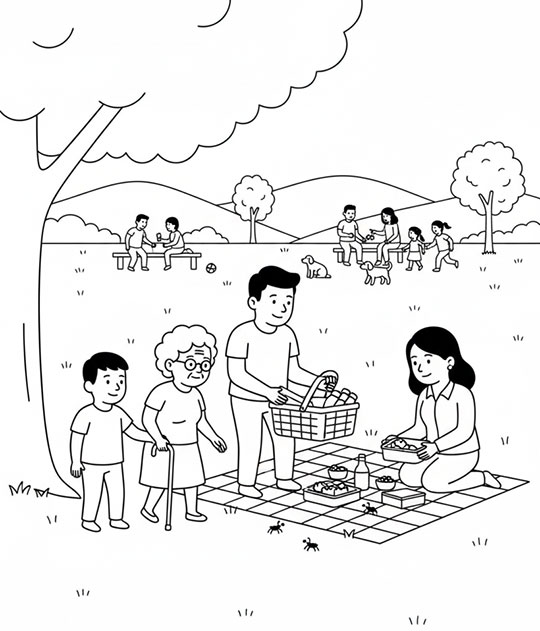
Sample MOE-Style Picture Discussion Question
Picture shows:
A family having a picnic in the park. A young boy is helping his grandmother walk, while parents set up food. Other families are playing in the background.
Examiner asks: “What do you see in this picture?”
TYPICAL P4 RESPONSE (Without S.T.E.P.)
“Um… I see a family. They are at the park. The boy is helping his grandmother. They are having picnic. Other people are playing. The weather is good.”
What’s wrong:
• No clear structure (just listing what they see)
• Simple, disconnected sentences
• No reasoning or deeper thinking
• Monotone delivery
• Basic vocabulary
Likely Score: Band 3-4 (Adequate/Developing)
RESPONSE USING THE S.T.E.P. METHOD
S – Structure: Beginning, Middle, End
BEGINNING (Overview): “This picture shows a heartwarming scene of a multi-generational family enjoying a picnic together at the park.”
MIDDLE (Details + Reasoning): “I notice a young boy thoughtfully helping his grandmother walk across the grass. This shows respect for elders, which is an important value in many families. Meanwhile, the parents are busy preparing the picnic food, and I can see other families in the background enjoying outdoor activities.”
END (Connection/Reflection): “This reminds me that spending quality time with family, especially with our elderly relatives, creates meaningful memories and strengthens family bonds.”
T – Thought: Complex Reasoning
The student demonstrates thinking beyond surface description by:
1. Making connections: “This shows respect for elders, which is an important value…”
2. Giving reasons: “…spending quality time with family creates meaningful memories…”
3. Personal relevance: “This reminds me that…”
4. Exploring implications: “…strengthens family bonds”
E – Expression: Voice & Body Language
Voice Modulation:
• Beginning: Warm, inviting tone on “heartwarming scene”
• Middle: Slight emphasis on “thoughtfully” and “important value”
• End: Reflective, softer tone on “meaningful memories”
Pacing:
• Slight pause after “enjoying a picnic together” (lets examiner absorb the overview)
• Deliberate pace through the middle section (allows examiner to follow reasoning)
• Steady, confident conclusion
Body Language:
• Maintains eye contact with examiner
• Natural hand gesture when mentioning “other families in the background”
• Slight smile when discussing “meaningful memories”
P – Precision: Targeted Vocabulary & Grammar
MOE-Aligned Vocabulary:
• “heartwarming scene” (emotional vocabulary)
• “multi-generational” (precise descriptor)
• “thoughtfully” (adverb showing manner)
• “quality time” (common phrase used correctly)
• “strengthens family bonds” (abstract concept)
Grammatical Structures:
• Complex sentence: “This shows respect for elders, which is an important value…”
• Present continuous: “are busy preparing”
• Connective: “Meanwhile”
• Comparative thinking: “reminds me that”
COMPARISON: BEFORE vs AFTER S.T.E.P.
| Criteria | Without S.T.E.P. | With S.T.E.P |
| Organization | Random listing | Clear beginning-middle-end |
| Thinking Level | Simple description | Reasoning + connections |
| Vocabulary | Basic (good, helping) | Sophisticated (heartwarming, multi-generational) |
| Expression | Monotone, hesitant | Modulated, confident |
| Engagement | Reads like a list | Feels like a conversation |
| Likely Band | Band 3-4 | Band 1-2 |
Follow-up question example
Examiner asks: “Why do you think it’s important for families to spend time together outdoors?”
WITHOUT S.T.E.P.:
“Um… because it is fun. And healthy. We can play together.”
WITH S.T.E.P.:
S – Structure:
“There are several important reasons. First… [main point]. Also… [second point]. Most importantly… [key insight].”
T – Thought:
“There are several important reasons. First, outdoor activities promote physical health and allow children to run around freely, which is difficult to do indoors. Also, being in nature helps family members disconnect from screens and have genuine conversations. Most importantly, these shared experiences create lasting memories that children will treasure as they grow older.”
E – Expression:
• Emphasizes “several important reasons” with confidence
• Uses natural gestures when mentioning “run around freely”
• Warm, reflective tone on “lasting memories”
P – Precision:
• “promote physical health” (sophisticated phrasing)
• “disconnect from screens” (contemporary, relevant)
• “genuine conversations” (precise word choice)
• “treasure as they grow older” (thoughtful vocabulary)
Result:
A response that shows depth of thinking, clear organization, and sophisticated expression—exactly what MOE oral descriptors reward at Band 1-2 level.